Interconditionality in Bai-Inah

One of the most controversial contracts that resides in Malaysia is the Bai Inah contract. For many years, Malaysia have been taking heat on its use from international forums. The major reasons for this critique is that Bai Inah, while having an underlying transaction in its structure, argues critics, smells suspiciously like a loan with interest. There have been many opinions to this, but I must admit that each argument has its own merits and rationale, and it is difficult to draw the line here.

What is Bai Inah?

But before going further, what is Bai Inah? Why is it always under the Islamic finance microscope for scrutiny? Why are feathers always ruffled when discussing Bai Inah?

Bai Inah Malaysia

 Please Click Here

Reliance on Commodity Murabahah

A few days ago, several Banks in Malaysia officially made available Deposit products based on Commodity Murabaha transactions.

Looks like Commodity Murabaha (CM), or in another variation is called “Tawarruq” has now expanded its domain from Financing-based to Deposit-based products. More and more banks will have to rely on this structure on both sides of the balance sheet. Bai-Inah based portfolio used to consist of nearly 80% of the overall financing portfolio of some banks; now with the push for Commodity Murabaha structures in financing to avoid interconditionality issues in Bai-Inah, it is expected that Commodity Murabaha financing to eventually replace the Bai-Inah portfolio.

Now with the introduction of CM for Deposits, the popularity of commodities will take a sharp rise! Bursa Malaysia will have their hands busy supplying the industry with commodities to support the underlying transactions. Islamic bankers will also have their hands full buying and selling commodities between the bourse and the customers, either as buying agents or principal purchasers!

Commodity Murabahah Deposits

I am not sure whether this is necessarily a good thing.

The industry will now shift from having a Bai-Inah-heavy portfolio into a Commodity-Murabaha-heavy portfolio. Concentration risks towards one Islamic contract will grow, and the question is that whether Banks will take the time to develop other contracts into viable propositions instead of just building the CM infrastructure. Do bear in mind that a lot of infrastructural work needs to be done to ensure CM remains the flagship contract for years to come.

The specific risks that Banks faced when offering CM products are manifold; shortage of commodities, delays in transactions,  wrong sequencing of purchase and sale of commodity, errors in commodity prices and description, delivery of commodities issues, ownership issues and ownership evidencing. All these requirements needs to be watertight to ensure income from these CM transactions don’t just go to charity. Whenever there is an Asset involved in the transaction, all the factors need to come together to ensure Sharia compliance.

And the way we are going, it seems that CM will probably have 80% of the financing pie and 70% of the deposits pie in a typical Islamic Bank’s balance sheet in 3-5 years time. With IFSA deadlines on June 2015, this ratio could come sooner rather than later.

Will the development of other contracts be further left behind since the shift now is on CM? Maybe, historically Malaysian Banks follows the “Urf Tijari” route of following what the other bank is doing. We have seen this when Bai Bithaman Ajil (BBA) was introduced; nothing else was developed in the market but BBA. It was the same with Bai Inah.

But there is other opportunities for development of other Islamic contracts, although I don’t imagine this is the case for Malaysia while we busy ourself becoming commodity traders. Oman, on the other hand, has rejected tawarruq totally,  focusing on other contracts such as Ijara and Musyaraka. This is a good development, as no countries has seriously looked at developing complex, high-risk structures. Maybe once the thinking to shift to understand the transactional and Sharia risks of the new products is made, perhaps the market can warm up to the idea that Sharia compliant banking can be a different way of banking.

Goods and Services Tax on Islamic Products

Goods Services Tax (GST)  will be one of the hot topics for the years to come in Malaysia, when the GST finally comes into place in 2015 to replace the Services Tax. Many arguments have been made on both side of the political divide but the reality is that GST will be implemented and have a huge impact on how services and goods are being priced.

A quick look at the GST finds that Sharia compliant banking, while having all its contracts requiring underlying transactions, asset ownership and movement of actual goods, the impact that the GST may have on Islamic contract will remain similar to what impacts a conventional banking product. There is not expected to have a “worse-off” effect on Sharia compliant banking.

GST

It is heartening to see that Customs has made an effort to understand the various Islamic banking contracts and how it works, and identify potential transactional points where a GST may be imposed. I find the attached document (GST Industry Guide – Islamic Banking (As at 1 November 2013)) extremely useful summary of the intended GST implementation on Sharia banking contracts.

10 particular contracts have been identified and the GST points are outlined accordingly.

Please Click Here

The Consequence of Choice

It was a day where nerves were frayed and feathers ruffled.

A huge potential customer comes. The intention is that they wanted to move all their accounts to Sharia-compliant banking, as they intend to “Islamicize” their business. All the available structures were laid out to the customer, the processes and the documentary procedures were explained for their understanding.

But suddenly, comes the golden question… “Do you have any products that looks and behave like a conventional product that we are familiar with? We are not comfortable with all these Islamic terms and documentations, so can we have something that does not require us to sign all these documents?”.

I was left speechless.

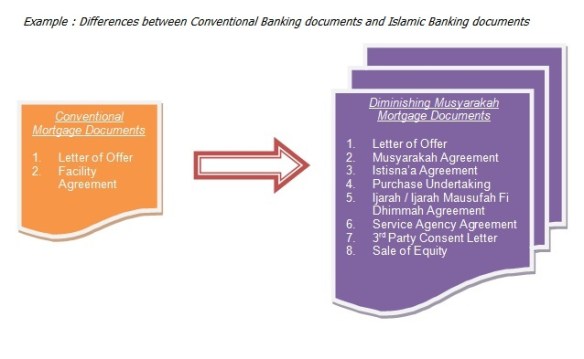
Sharia-compliant banking is based on contractual relationships. There are many relationships; Musyaraka, Murabaha, Ijara, Mudharaba, Istis’na… Various and many depending on use, intention, and desired outcome. There must be an underlying transaction, governed by specific rules and tenets, and pays attention even to sequencing requirements, ownerships, rights and usufruct.

Documentary Islamic

Fundamentally it is different from a conventional banking structure, which is loan based and interest charging. Thus documentation for a non-Sharia banking product is essentially one core document; Facility Agreement. But that may not necessarily be the case for Sharia banking, where documents are crucial evidence for the underlying transaction, ownership and obligations.

To make that conscious decision to shift to Sharia-banking is admirable. But to insist on a structure they are used to in conventional banks makes this effort superficial. It is frustrating to explain that each Sharia-compliant product behaves in a certain manner and must comply with the tenets captured in various documents; no matter how much a customer envision the product feature and documentation should be instead. A Sharia-compliant 1-month Term Deposit based on Qardh (ease of documentation) but with guarantee of returns? How would we pull that off? It is a contradiction in concepts.

Customers need to understand that to choose Sharia-banking is to accept the rules and trimmings that comes with this model. It is not the same as the conventional model, although at many times we try to replicate what’s available in the conventional space to avoid confusion. Replication is there for convenience but the DNA of Sharia-compliant banking is different. With replication then enhancement and eventual replacement, we hope awareness in Sharia-compliant products may come in gradual stages.

I think it all boils down to the lack of understanding what is required for us to offer Sharia-compliant banking. The layers we go through are numerous, stricter regulatory requirements and Sharia rules to follow. Turnaround times for Sharia-compliant product is understandably slower, where there is intense scrutiny on contractual relationships, legality and Sharia-sensibilities.

It is tough to be an Islamic banker. We manage perceptions, expectations and responsibility not only to the Bank’s customers, but also to general consumers. To choose this model, consumer must be open to the fact that Sharia-compliant banking is similar but definitely not the same as a conventional model. There is a lack of awareness of what is involved but we need to be open to an idea. Everyone knows the conventional model, therefore do take time to understand Sharia-compliant banking as a new learning instead on trying to hammer a conventional-familiarity into a model which works based on risk-sharing, relationships, and contractual certainties and tenets.

May I have a calm week ahead.

Pro-Active Compliance of Regulatory Guidelines

There are days I wish I was a multi-millionaire with vast resources, cool regulatory connections, tech-savvy and excellent people motivator. Someone who sees the new regulations for the opportunity it is and the potential in it.

If I was, I’d quit my cosy banking job and set-up my own company that provide services to all Malaysian Banks to support the compliance of the new guidelines. Instead of all the banks scrambling to meet the requirements, they can just outsource all their problems to my set-up to run it. One stop solution to all your headaches.

Perhaps I am writing this out of frustration because I do not have the resources for it. Or perhaps I am writing this for my own interest, hoping someone like Bruce Wayne takes up the challenge and make all our jobs easier. Maybe some of us can get an offer to join this company. That’s wishful thinking I bet.

What would this company / set-up offer to banks? Hmmm where do we start.

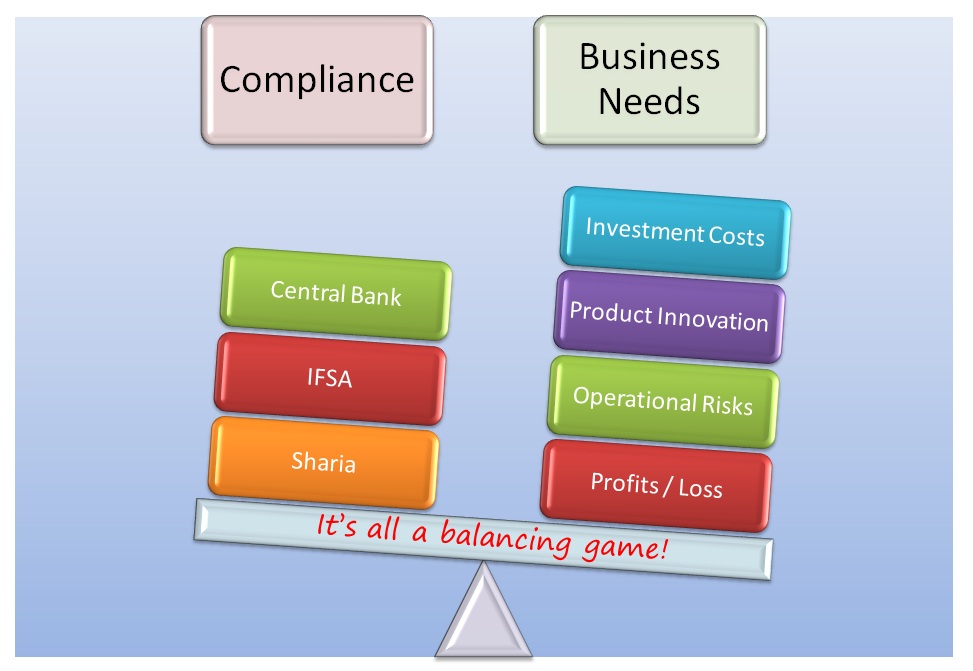
Balancing Act

Compliance with the Investment Account Guidelines.

All Banks do not generally set up their operations to work like fund houses where you have fund managers running their investment desks. Neither are there an infrastructure to manage and monitor the fund or portfolio performance, nor having mechanisms to create mark-to-market valuations of the portfolio. Reading the Investment Account guidelines makes one think that the banking model itself has to change to a pure Mudharaba trading house. A dedicated fund house with ready systems supporting the investment requirements and offering their services to Islamic Banks will ease the burden at Banks to develop their own infrastructure.

Tawarruq Guidelines.

This can be a huge component of businesses in the near future. As BNM place more and more emphasis on the big 3 of Musyaraka, Mudharaba and Murabaha, more and more focus will be placed on building the long term infrastructure to support this. Warehousing infrastructure, including managing physical assets and commodities belonging to the Banks, will support the Murabaha envisioned by BNM. A re-vamp of the credit policies and a different approach to risks assessment will support Musyaraka. Mudharaba will encourage the Bank’s “entrepreneurial appetite”  as Banks take a more hands-on approach to investments. Ensuring a compliant structure and supporting the requirements of Sharia on sequencing, documentation, management of commodities, ownership transfers, usufruct and beneficial ownerships and valuation must be developed for the long run. A company which offers these services, or provides an IT platform for this, are something that can reduce the stress placed on the industry.

Special Purpose Vehicles (SPVs).

There a easy lot of opportunities for SPVs to flourish in the Islamic banking market. To support the ownership issues, an SPV can be a useful conduit for the movement of assets which will then create the underlying transactions. Huge deals are done on SPVs. Complicated structures need them. This is a viable legal solution for across border deals. The only question is; what do we do with the SPVs once the transaction is done? Rent it out to another entity, I presume. Either way, SPVs are created for win-win situations for everybody.

The IFSA 2013 is like a large pool of compliance that needed development. There are many opportunities out there and with the coming of even more complicated regulations, Banks are always finding ways to meet the requirements set in the regulations. Some will be creative solutions, while others will address the fundamental requirements of the transaction. Whatever they may be, it will only provide possibilities where fortune smiles on the brave. Take that chance. Hopefully, you will succeed to make all our lives easier.

Banking with Non-Islamic Banking Institutions

I remember many years ago being in an interesting conversation with my Bank’s Sharia Advisor on the topic of accepting funds from an organisation which deals with non-sharia compliant activities. What was the view on taking funds you know were generated from doubtful sources. Whether it is reputationally acceptable to take in deposits from customers involved in gambling, usury and prohibited activities.

Some institutions were reluctant to take in these institutions as customers, even though they were huge, cash-rich corporations. The worry is on the perception that we Islamic bankers are supporting them via our activities, that they benefit from their patronage of our bank. Some even said that taking their “dirty” money and putting it into our pool of “clean” funds will result in co-mingling of the funds. The fact that we provide services to non-Sharia compliant institutions, bothered some quarters.

My advisor said it simply. Why not we take their funds? If you don’t take it, where would it then go? It will go back into the conventional system, generate more money, providing more funds to allow the conventional banks to loan the money to more customers. This will grow the conventional pool of funds, increase the loans portfolio in interest-lending and further strengthen a conventional banks profit. Islamic banks will then have to grow organically, fighting for the piece of pie that’s available against huge conventional banking giants.

Take the money. Invest in Islamic industry. Grow our books. Invest in Sharia-compliant manner. And provide good returns to the conventional depositors and investors. Change their mind by proving that Islamic banking is universal. That the model is viable. Innovative, competitive and fair. Provide the alternative for a feasible banking structure. Give da’wah and awareness on Islamic banking and its underlying principles. Prove we can co-exist side by side.

Probably one of the wisest things I have heard. Although not many will have the same sentiment to this. So it is ok to agree to disagree.
Investment by Conventional Banks
But what if it is the other way around? Can an Islamic Bank invest or place their deposits with a conventional banking counterpart, who deals in non-compliant activities? The answer is obviously a NO. Depositors funds, taken under a Sharia-compliant contract, should be used for sharia approved activities only. Morally, it is wrong to paint a picture that the Bank is Sharia-compliant but is actually a deposit collection arm of the Non-Sharia-compliant bank. It’s misleading and damaging to the Islamic bank to have this reputation.

Investment in Conventional Bank

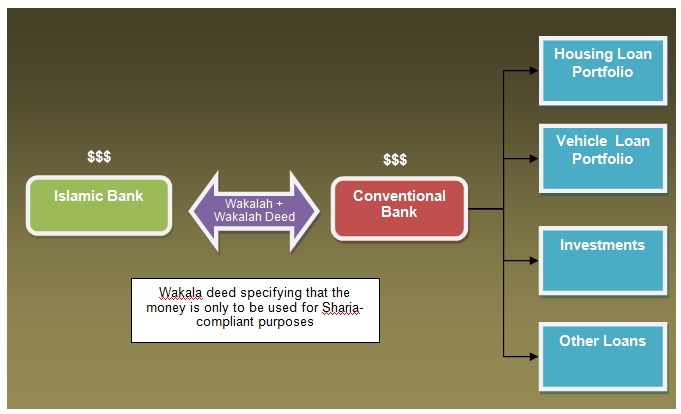
Yet, is there a solution to this argument? What if we still deposit funds into a conventional bank, yet with a strict condition put on the use of these fund for Sharia compliant investments only? Will that be enough to allay the concerns? If it does, what is the relationship that will be between us and a conventional bank? Can we appoint a conventional bank as our “Wakeel” to execute Sharia compliant transactions?

Personally, I do have reservations on this. Conventional banks do not have any compulsion on the execution of a transaction whether Islamic or otherwise. They do not bother about its use or matters such as sequencing or ownership. Their law is civil law, and is dependent on the legal documentation. This, then, is merely passing of money to a conventional entity, when our depositors have trusted us to invest in Sharia compliant activities. Can we be assured that the monies passed over be used according to our requirements? How do we get this assurance?

What is your Bank doing? Can this be a possible model?

Sharia Compliant Banking in Malaysia

One of the long running arguments on Islamic Banking in its current state is the level of compliance to the rules of Sharia. There are still many believers out there who are not really believing in Islamic Banking. There are many suspicions in the industry. The main one is that Islamic Banking is a copy of conventional banking with merely a Sharia wrapper around it.

Sharia CompliantThis view is admittedly hard to dispel, unfortunately. Especially in a market where the industry is running 2 parallel banking systems ie Islamic Banking and Conventional Banking side by side. Sometimes, there is an additional element ie Islamic Banking Windows where an Islamic Banking operation resides in a conventional banking, leveraging totally on the conventional banking infrastructure.

The Middle-East has been able to gain more focus on the development of Islamic Banking. Despite Malaysia being one of the prominent pioneers of the industry, the stability of what we are seeing in the Middle-East has been the focus of ensuring the products they offer are deemed more Sharia compliant. While Malaysia is coming out with innovations to catch up with competition from conventional banks, the Middle-East is looking to products they already have and improving them to ensure Sharia compliance, fully backed by an international Shari’a framework.

This is clearly a different approach to the development between the two Islamic Banking industry.

In my view, the Middle-East has a clear advantage when in comes to sustainability. The advantage is simply this; the wants of the consumer. The Middle-East consumer simply WANTS Islamic Banking. No question about it. The consumers are split to either want Islamic Banking or does not want Islamic Banking. The trend is shifting away from the view that they are indifferent to any banking structure. There is a growth in preference for Islamic Banking, and this is the main driver for the development of the industry.

Malaysia, on the other hand, has a different set of consumers. The Malaysian consumers, whom may be just as pious as their Middle-Eastern brothers, continues to view the Islamic offerings with deep suspicion, which mould the attitudes towards Islamic banking industry. Admittedly, some Islamic Banking contracts have been disputed, tested and contested in a court of law, and in some cases the banks are not able defend these contracts properly. Reputational damage done; and some quarters have taken advantage in making the molehill bigger than it really was.

In Malaysia, the consumers only want and expect certain things from their banking product; cost savings features with full benefits, cheap pricing and easy to use. There is strong preference for Islamic Banking products but if there is a better alternative in the conventional banking space, the attitude is “Why not?”. At the end of the day, it all comes down to dollars and sens; “How much does it cost, what savings do I get, how much do I save”? Islamic or non-Islamic? It is all about what money I earn or save which I can use for my family and myself.

Maybe economic standing of the consumers do play a part. A product in Malaysia seems to be more about justice, even if it is just a misplaced perception, and therefore it must be cheap. Islamic Banking products in Malaysia have evolved significantly since its inception in the early 80’s. It is now more equitable, competitive and in many cases, has more “justice” elements in its structure. The issues that may arise 10 years ago, in my view, has already been looked at and smoothed out.

Bank Negara Malaysia (BNM) has introduced many measure to support this idea of justice. The Ibra guidelines to ensure equitable settlement. Regulated Late Payment Charges to ensure consumer rights are protected. Synchronisation with the conventional banks on Responsible Financing and Product Transparency. Tight regulations of the Fees and Charges that an Islamic bank can charge to consumers. Does anyone know how rigorous the process BNM has imposed to approve fees and charges that an Islamic Bank can charge? 4 levels of approval at BNM, even after the Bank’s internal Sharia Committees have approved those charges. To get approval from the internal committee is already tough; to go to BNM to get the final approval is not something we look forward to.

These are good steps, but is it enough? Will the Malaysian consumer take that quantum shift to buy into Islamic banking products?
SSBAs I mentioned earlier, the main difference between what’s happening in the Middle-East and Malaysia is the consumer preference. In Malaysia, the consumer wants a product that provides justice to them, whether it’s pricing or features or convenience. Islamic or otherwise, it’s the job of Islamic Banks to win them over.

Therefore, this difference in the consumers mindset in the Middle-East may eventually be an important factor. Since Middle-East consumers just WANT Islamic banking, the industry there is given the benefit of the doubt for its development. Because of this, the emphasis of the development is more on Sharia compliance rather than just pricing, features and innovation.

fatwa

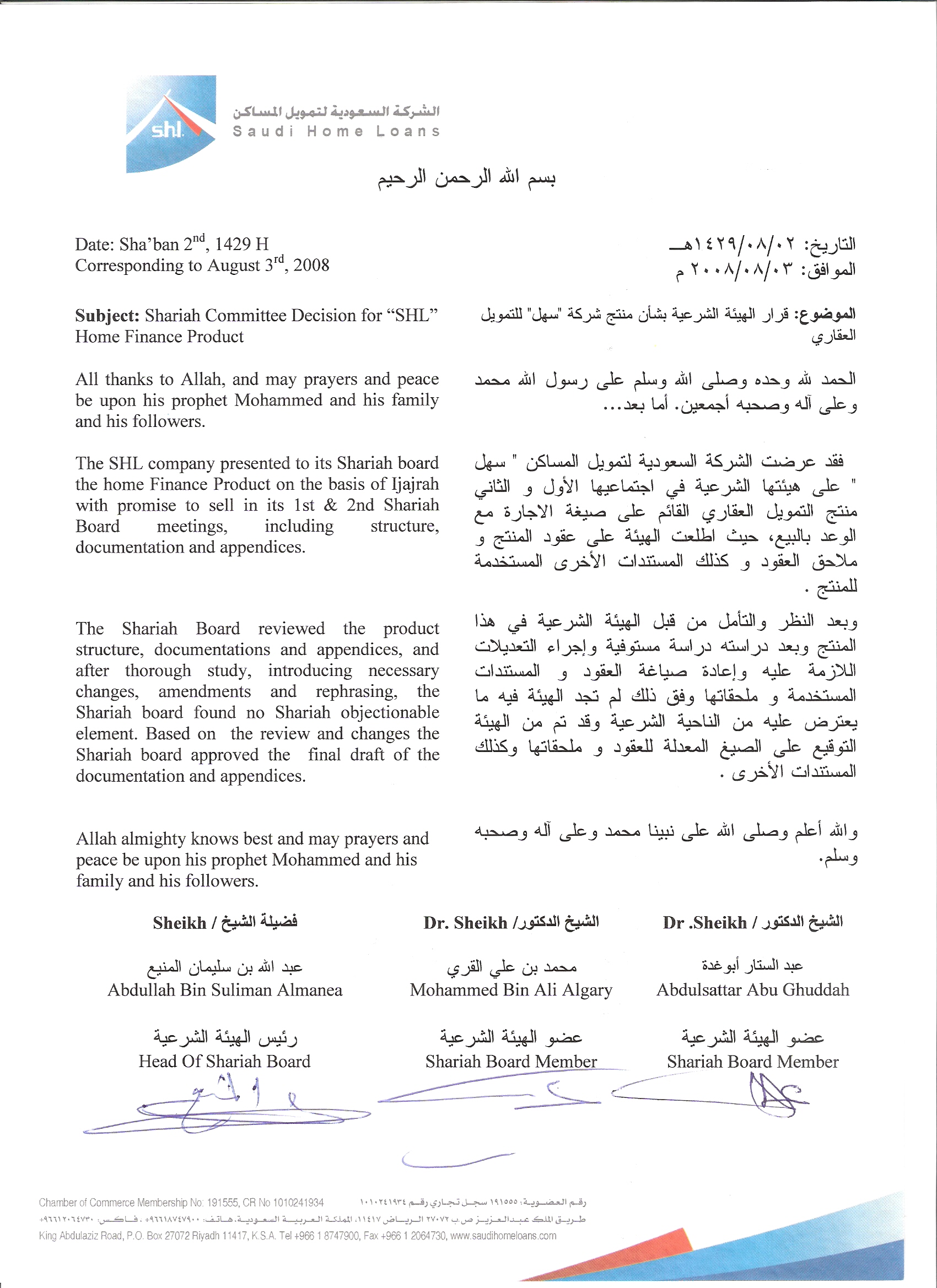
My limited experience in the Middle-East led me to one important conclusion; consumers want the comfort that when they choose Islamic Banking, the product must assure it meets the Sharia compliance required. By this, it is important to know the people who develop and approve the products. Great weight is placed on the names and reputation of the Sharia scholars themselves. Consumers genuinely want to know who approves the product structure, and want to see the scholars stamp on it. Requests for a copy of the fatwa governing the approval of the product is a norm in the Middle-East. As mentioned, the emphasis is on Sharia compliance, more than merely pricing. There is a huge trust and confidence in the Sharia scholars themselves, in their ability and the quality of decisions made on the products.

For that, I do applaud the consumers who chose Islamic Banking for looking beyond pricing. Many times I have been asked to furnish details and profiles of the Sharia scholars who approved the products. The decision to buy the product is more often than not, based on these profiles. The assurance of Sharia compliant banking became more important, even though there are better pricing elsewhere. And I believe that product innovation will have to come naturally once the performance of the Islamic banking industry is in the upswing. Competition and customer feedback drives innovation, but in the first place we need the right customers asking for the right solutions to be banking with us. As pricing and feature becomes the second priority, the Middle-East banks will be well placed to take a step back and assess compliance and therefore build consumer confidence organically.

Furthermore, many corporates and government-linked institutions mandates their financial dealings to be Sharia compliant, even making it part of their constitution and governance. This will drive the demand for Sharia compliant banking even more. With a ready market seeking, looking and wanting Islamic products and services, one can foresee a sustainable growth in the industry.

I don’t know what can possibly change the consumer mindset for this in Malaysia. Until then, we will always be playing catch up with the conventional banks even when BNM is pushing for a more wholesome Sharia compliant banking system. It could be a painful transition that the Banks will find difficult to stomach when the existing structure seemed to be working well. But without this change, will the industry ever make that quantum leap?

It’s catch-22. Someone needs to be bold enough to see it out, bite the bullet and draw that line in the sand; take a chance on Islamic banking with confidence and without so much suspicion. Maybe that is what is needed to make that paradigm shift in consumers.

Synopsis of 2013 BNM Exposure Drafts

The following is what I understood from the various Exposure Drafts issued by BNM on 9 December 2013. Of the 7 exposure drafts that we received, I have earlier summarised the Wadiah Exposure Draft, and I will ignore the Bai-Inah Exposure Draft as we are no longer subscribing to the Bai Inah structure at the workplace.

Please find the remaining Exposure Draft review for your understanding.

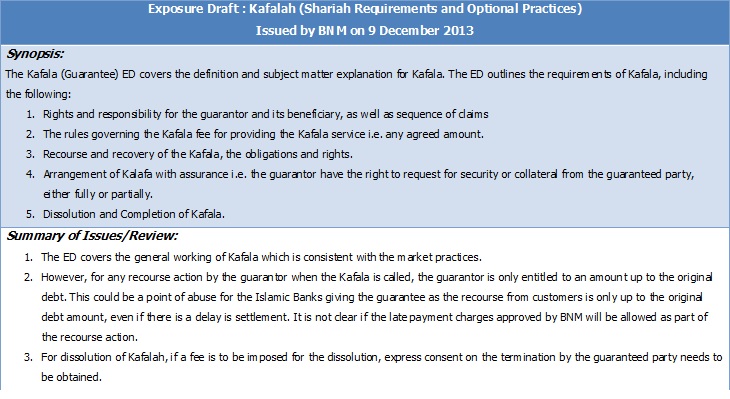
Kafalah ED

2013 ED – Kafalah – One of the key issues for a Kafala (Guarantee) contract is the charging of fees for providing the guarantee services. The main issue has always been the quantum of fees charged, either in percentage of the financing or via a fixed charge for all financing amount. The justification of this charge is always tricky, because technically the fee should not be imposed if there is no call for the guarantee (in cases of no default). The guarantee will only materialise if the customer defaults, that’s when the work happens to justify any fees. Issuing a piece of paper at the start of the relationship to guarantee the amount does not amount to too much work, and there no funds disbursed to any parties (unfunded). To justify the charging of any fees based on percentage instead of actual work, especially for huge amounts of financing guarantee, can be problematic to justify in the eyes of Sharia.

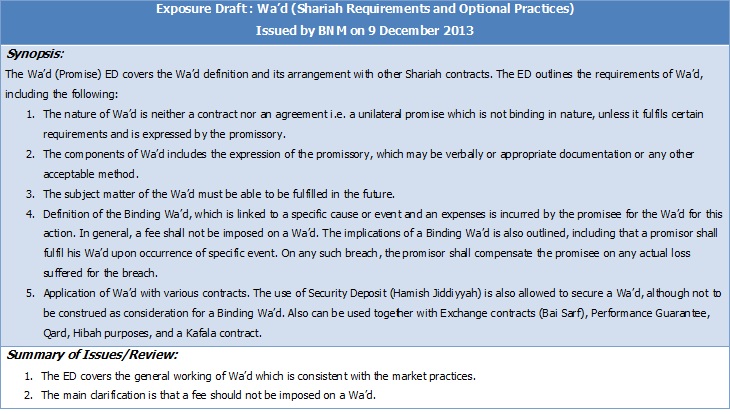
Waad ED

2013 ED – Wa’d – At one point of time, Wa’ad (Promise) seems to be the answer to many structures, where a promise is given without any requirement to transact before a specific event. The terms therefore can be negotiated and re-negotiated without the need to strictly specify the terms of the transaction and re-signing of documents. This gives a lot of leeway for deals to happen.However, at the end of the day, Wa’ad remains as only a promise, legally distanced from a contract or an agreement. Enforcement at the courts are therefore without full confirmation of all the terms, and makes for a loose structure and potential disputes. This flexibility and enforceability remains one of the key risks to a Wa’ad contract, which is why until today Wa’ad is generally transacted between known parties i.e. between established and trusted Financial Institutions.

Wakala ED

2013 ED – Wakalah – Wakala (Agency) will remain an integral contract for Islamic Banking as it validates a lot of action that can be done by the Bank, in order to remain efficient. In general, Banks hold a lot of expertise in various fields, such as investments, financing, leasing and trading; something a normal customer may not want to be involved in on a daily basis. An Agency arrangement conveniently provides for this. Anything that improves the efficiency by leveraging on the Bank’s expertise and infrastructure, can be arranged via Agency. However, the way we practice it usually is transparent to the customer. In practice, Agency Fees are the right of the Agent, and the waiver of such fees, although allowed, is sometime seen as not adhering to the spirit of Agency and entrepreneurship. You do the work as an Agent, but don’t earn any fees as it is waived. In real life, this does not happen as whenever a work is completed, you should earn something.

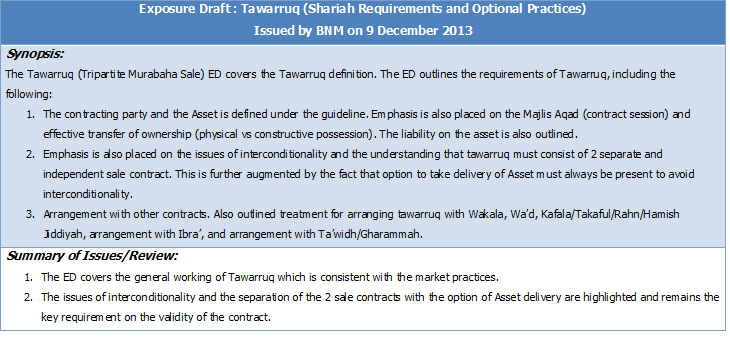
Tawarruq

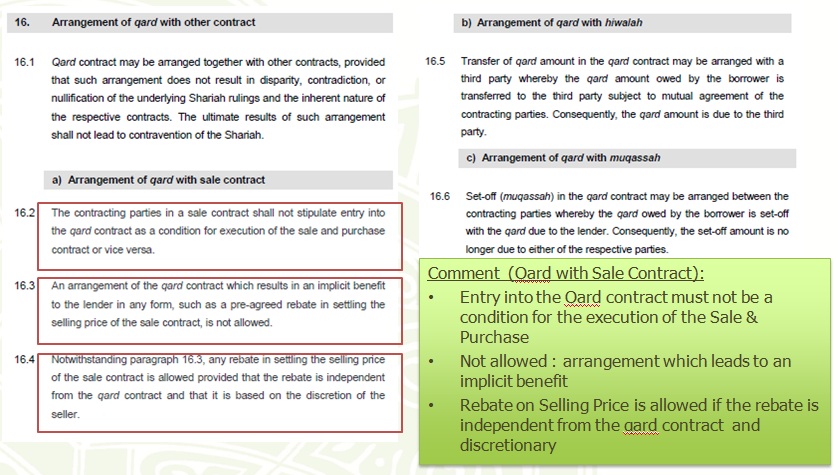
2013 ED – Tawarruq – As Tawarruq (Three-party Murabaha Sale) becomes more prominent in the Malaysian market, I was surprised that the ED was not more comprehensive than this. There are sequencing issues not addressed but more importantly, there is a lack of illustration on what is defined as Tawarruq. Is there any difference between a Tawarruq and Commodity Murabaha, which essentially is a 4 party transaction? The issue of interconditionality is adequately addressed in the ED but I would love to have seen more details related to products, such as for Islamic Credit Cards and Revolving Credit with a rebate structure (Ibra’) based on a floating rate financing. It mentions that the discount can be given based on certain benchmark agreed by the contracting parties. This opens the clause to various interpretation as it is without real detail.

I will look at the Hibah (Gift) ED but essentially, it is related to the Wadiah ED. Most of what’s covered under the Hibah ED is relevant to the Wadiah product, such as the discretionary Hibah issue and the giving of Hibah becoming a business practice (Urf Tijari) which can be construed as Riba (Usury). Wait for the posting.

Thank you for reading, hope everyone have an enjoyable holiday period ahead. Wasalam.

Readings : December Papers x 3

Murabaha

And to close off the year, BNM gave us a further 3 reading gifts for us to enjoy our holidays:

  1. Murabahah (2013)
  2. CP Mudarabah (SR,OP, OR)
  3. CP Musharakah (SR,OP,OR)

The Murabahah Standards looks interesting, and so is the Mudarabah Concept Paper. Do have a read and tell us what you think.

Looking forward to the coming holidays.

Exposure Draft : Wadiah

Image

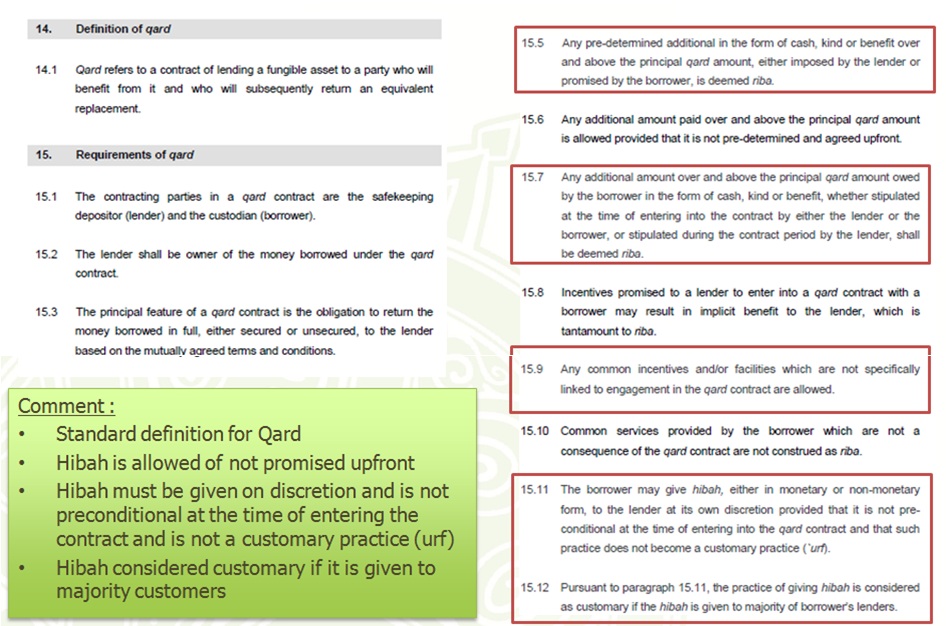
One of the panic buttons we are pressing now is the new Wadiah Exposure Draft (ED). As a rule, Wadiah is a “safe-keeping with guarantee” arrangement, where a Bank agrees to take on-board customers deposits as a loan (Qardh). And in the rules of loan under Islamic Banking, a loan must be returned on the same amount when required; any amount above and beyond the loan amount, if put as a condition at the start or during of the deposit placement, may be construed as “Riba”. If the Bank utilises the deposits for any business activities, the Bank is given the discretion to award “Hibah” or gift payments allocated based on the balance outstanding.

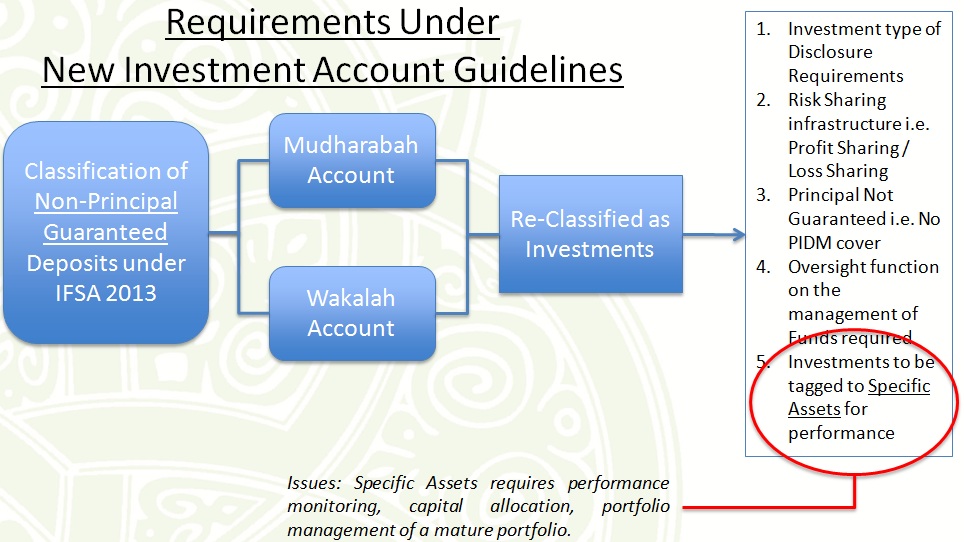
With the introduction of the IFSA and the requirements that Malaysian Banks comply with the Investment Account Framework  if Mudarabah continued to be offered to Customers, the common wisdom is to migrate lock-stock-and-barrel into a Wadiah account. In my earlier writings, I already mentioned that to comply with the Investment Account Framework, a massive shift in thinking, processes, and management is required. Therefore to convert into a Wadiah structure may not be the ideal solution, but it will provide an “easier” route towards retaining Customers’ deposit.

Wadiah ED

However, in this chess game between the Islamic Banks and Bank Negara Malaysia (BNM), the new ED is introduced on Wadiah has effectively further tied the hands of the industry players. BNM had anticipated the industry intentions to move the Mudarabah structure into Wadiah, and promptly outlined further restrictions on Wadiah itself. The industry is now caught between a cold and hard place; stay with Mudarabah and comply with Investment Account Framework, or migrate into Wadiah and comply with the new Wadiah Guidelines.

Wadiah Concept Paper

As we know, Wadiah also puts significant limitation on the marketing of returns and benefits to customers for their deposits. BNM took this a step further; to emphasize that returns on a Wadiah account should always be discretionary, as Wadiah is now seen as a loan. The impact comes in several clauses in the Exposure Draft:

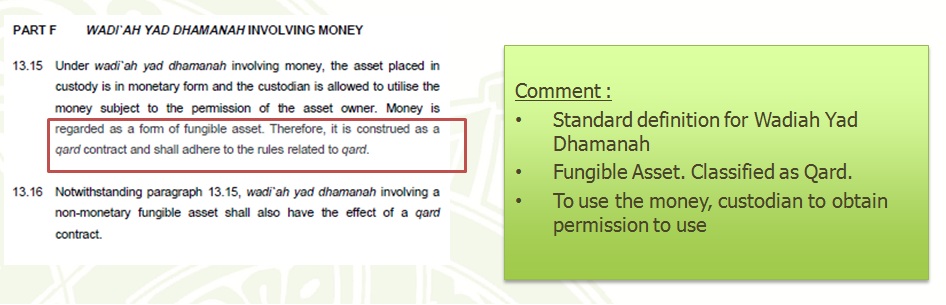
  1. Wadiah Yad Dhammanh is considered similar in nature to Qard. Therefore the rules of Qardh should also apply to Wadiah.
  2. A majority of customers should not be getting a return on the deposit under Qardh. Generally this is saying that out of 100 customers, only 49% of customer will be given a “gift” on their deposits
  3. The payment of the discretionary “gift” should not be construed as regular or common business practice (Urf’ Tijari) else it will imply that the “gift” is a constant return to the customer. Historical performance can be shown to customers.
  4. Any benefits, monetary or otherwise, deriving directly from the placement in the Wadiah account may be construed as “Riba” as well.
  5. Any benefits includes scenarios where should the Wadiah account be opened as part of a financing facility, and benefits enjoyed in the financing facility from amounts available in the Wadiah account (for example a rebate structure to off-set an obligation), shall be construed as riba’ as well.

My main question is; now that Mudharabah is turned into a pure investment account, and Wadiah carrying so many restrictions, what other solutions are there? It cannot be that BNM only expects us to comply but do not help with a viable solution on these restrictions. Yes we are looking at the Commodity Murabahah structures, but operationally this will be a challenge for the Banks to control the cost of commodity trade.

Wadiah ED

And how do we define majority, then? The system must now be enhanced to determine who gets the discretionary “gifts” based on which formula. Even if they qualify for the discretionary “gifts”, to award them on a regular basis will also lead to it be construed as “Urf Tijari”, where consistent payment of Hibah will imply a similar future returns. How do we define this “non-majority” of Customers whom qualifies for Hibah but do not get regular awards of Hibah? What system logic can we build and will what we build be acceptable to Sharia? More importantly, would the customer even accept such “discretionary” practice?

Now that BNM has issued a new Concept Paper on Shariah Requirements, Optional Practices and Operational Requirements of Mudarabah today, we get a somewhat watered-down requirements to Mudarabah products. I have read it and saw that under this new Framework, the Mudarabah structure remains viable as it is, with enhancements needed for documentation and disclosures. Manageable and workable. The next steps must be; if we were to stick with Mudarabah, which Framework will take precedent. Mudarabah is an Investment structure. So, would we follow the Mudarabah Framework, or to comply with the Investment Account Framework? Both Frameworks makes reference to each other; yet one is stricter than the other.

I am putting all my hopes on the new Framework. That will give me some leeway of having both Wadiah structure and a viable Mudarabah structure (not based on the Investment Account Framework). This is definitely the light at the end of the tunnel. But as usual, indications are to take the “stricter” guidelines into account, rather than keeping hope for an easier implementation.

Exposure Drafts for 2013

ImageToday we are given additional reading materials; Exposure Drafts!!!

By my last count, 7 new Exposure Drafts was published by BNM yesterday and now it is time to digest them. As it is, there is so many to digest already. Quick and fast after the Bai-Inah clarifications in late 2012, we were given tight deadlines for the IFSA bill to comply. Add to that, the IFSA “forces” us to re-look at the Investment Account Concept Paper and the Rate of Return Framework if we were to look at retaining a Mudaraba or Wakala deposit structure. Then comes the deadline that the compliance to the Investment Account concept paper is to be met by 30 June 2014.

More sleepless nights? Yes, especially since the industry is struggling in coming up with a Current Account Savings Account alternative to Mudaraba.

Now we welcome the new Exposure Drafts and the boss has given me 2 days to read the relevant ones. Will I be able to digest them? The names of my new friends as follows:

  1. Exposure Draft for Wakalah
  2. Exposure Draft for Wa’d
  3. Exposure Draft for Bai Inah
  4. Exposure Draft for  Hibah
  5. Exposure Draft for Tawarruq
  6. Exposure Draft for Kafalah
  7. Exposure Draft for Wadi`ah

And generally, Exposure Draft is like the engagement before a marriage. You may give feedback, but the deal is already on. It is just a formality.

This will make for an interesting reading, and an even more interesting new year.

Back To Wadiah

Investment Account Guidelines

True to form, BNM have called for an urgent discussion with the industry players on the implementation of the IFSA. The message is very simple; industry players are given time to comply to the IFSA i.e. no later than 30 June 2015. During this time, we are asked to either:

  1. Retain Mudharabah and Wakala structures to comply with the Investment Account guidelines; or
  2. Move the Mudharabah and Wakala structures into an alternative structure.

Obviously no one has the answer to both options. Especially for Current Account and Savings Account now offered under Mudharabah. To retain a simple product such as Savings Account under Mudharabah, the Bank needs to comply with tedious risk profiling of customers and numerous disclaimers on investments. Customers will be confused by this arrangement, and we foresee many will stay away. Marketing wise, it is a nightmare. Operationally as well, if we were to comply with the investment disclosures. Gone will be the simple structures that customers are used to.

Bringing the Current Account and Savings Account into Commodity Murabahah structures is the most viable solution in Shariah’s perspective. However, operationally tedious, money required for system development, revised documentation and more importantly, building customer awareness and acceptance will be the main challenges for the industry to move to this alternative.

Committees were promptly set-up to discuss solutions, and as expected, there can be no commercial viability into moving to Commodity Murabahah, at least not in such a short period of time. For Time Deposits it is possible, but how to address the daily deposits and withdrawals of funds in a Current or Savings Account under Commodity Murabahah?

The easy solution; take a step backwards.

Wadiah is suddenly the solution. Most Banks has decided to migrate back into Wadiah structures, even with limited value proposition. Hang on, this is not the solution. Perhaps only workable for a short term stop-gap measure, but definitely not feasible for moving forward, especially when there is a conventional banking alternative.

Wadiah is definitely not the solution for deposit building. But then, what else is there? Until someone comes up with a brilliant solution, we will have to make the best of what Wadiah has to offer.

The Islamic Financial Services Act

IFSA

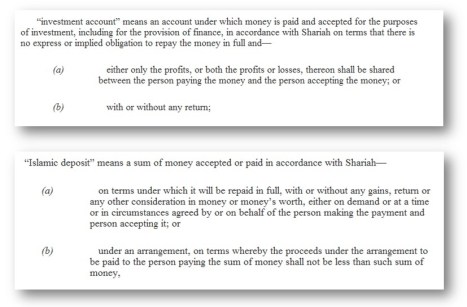
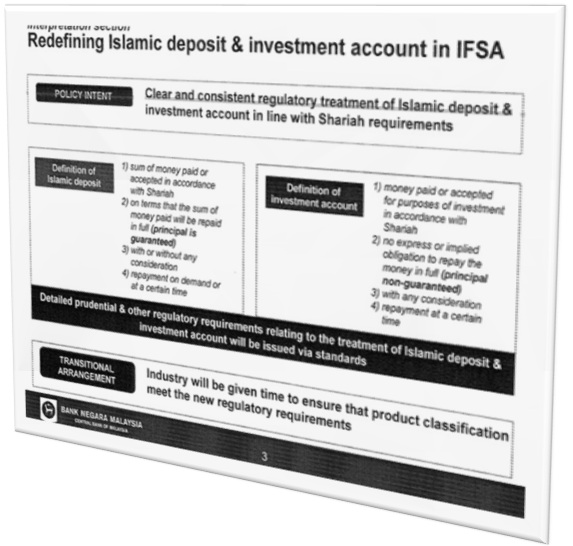
The Islamic Financial Services Act (IFSA) 2013 was introduced to streamline the Islamic Banking definitions and practices. With the introduction of this Act, we obtained clarity on many matters, but not all of it is in our favour. From the Act, we see a significant re-defining of the Deposit product. Needless to say, the Islamic Banking industry is at arms on this new definition.

IFSA DEF

But to classify it as a new definition is also not entirely accurate. We have been taking in Mudaraba-based deposits as our main method of accumulating deposits in the Bank. Mudaraba by nature is profit-sharing investment arrangement for the purpose of obtaining a return. Any profits arising from this investment will be shared amongst the entrepreneur and the capital provider based on agreed ratio; whereas for any losses, it will be borne by the capital provider, unless the entrepreneur is proven negligent. In all intent and purposes, this is an investment, rather than deposits.

However, while there is a risk to the investment, this is mitigated by way of investing in low risk intruments, profit equalisation or even gift (hibah) to ensure a customer’s capital is not lost. Technically an investment, but with indirectly guaranteed capital due to the above mechanisms. Furthermore, this is augmented with the deposit insurance offered by the Malaysian Deposit Insurance Corporation (PIDM) which insures the customer’s deposit with the Bank, should a Bank goes belly-up.

With such assurances, Banks have taken these Mudaraba placements as “Deposits”, categorised internally as part of the Core Deposits calculations i.e. low risk deposits. Why this is important is because if you have higher Core Deposits in your books, you can therefore fund a higher proportion of your financing portfolio, without adding more Shareholder’s capital. Technically, under the Loans to Deposit Ratio (L/D Ratio), the Bank can hold a bigger financing portfolio the higher the Core Deposit amount.

This is the desirable outcome. To collect higher “Core Deposits” via Savings Account, Current Account and General Investment Account (Term Deposits).

With the new IFSA, the Core Deposit definition is redefined.

  1. If the return of the customers deposit (capital) can be guaranteed, this capital is classified as Deposits.
  2. If the return of the customers deposit (capital) cannot be guaranteed, this capital is classified as Investments.

With this, the industry is turned on its head.

Redefining Deposits

Obviously, a Mudaraba, or Wakala fi Istihmar (Agency for the purpose of Investment) will be classified as “non-Core Deposits”. The nature of Mudaraba is investment, and no matter what mechanism one puts into the product to “protect capital”, one cannot GUARANTEE capital due to the potential of loss. This risk sharing is one of the key tenets of a Mudaraba arrangement. By keeping to this tenet, Mudaraba should be classified in its rightful place i.e. Investment.

As mentioned, removing the deposits as reclassifying it into Investment has significant impact on the L/D Ratios.

But also, what’s worrying is that to keep Mudarabah (or Wakala), now defined as Investments, there is a separate Investment Account Guidelines which the Banks will have to comply with. Now that’s another story.

As an industry, we are faced with an option of either:

  1. Building our Core Deposits via an alternative product which Guarantees the capital. We have the readily available Wadiah structure, which is similar to a Qard deposit structure where no benefits can be offered or promised to the customer for their deposits; or
  2. Comply with the Investment Account Guidelines to keep with Mudaraba or Wakala Investment, but will not be able to include those amount into the Core Deposit calculations; or
  3. Develop new deposit structures that will meet both the Deposit definitions and meet customer demands for returns on their deposits and savings. Unfortunately, the available structures in the market requires extensive capital and technological enhancement, while operationally not viable. The industry as a whole has so far not come up with any viable proposition. Research has been done but the disadvantages of such structures outweigh the benefits.

This re-classification, may on the onset, looks a simple thing. But the impact is huge. The risk of capital flight is significant, possibly flight into conventional banking if the consumers are not able to accept the risks of investments or the returns uncertainty of deposits. It will be interesting to see what the industry comes up with.

I remember following BNM briefing on the re-classification back in 2011, the boss has asked me to come up with a Term Deposit under the contract of Wadiah. He knows it is not feasible, but still he asked for it. It only reflects how desperate the time will become when the full significance of the Act is enforced on us.

Now that it is enforced, I wondered if the rope around my neck is long enough.